Efficient Computational Modeling and Uncertainty Quantification
High-fidelity computational models provide detailed information on cardiovascular flow and mechanics but often require substantial computational resources. We develop physics-based reduced-order models that retain geometry-dependent hemodynamic characteristics at a lower computational cost. We combine these models with probabilistic methods to quantify variability in model predictions and identify influential physiological and mechanical parameters. This framework supports efficient parameter studies, uncertainty quantification, and sensitivity analysis in subject-specific cardiovascular simulations.
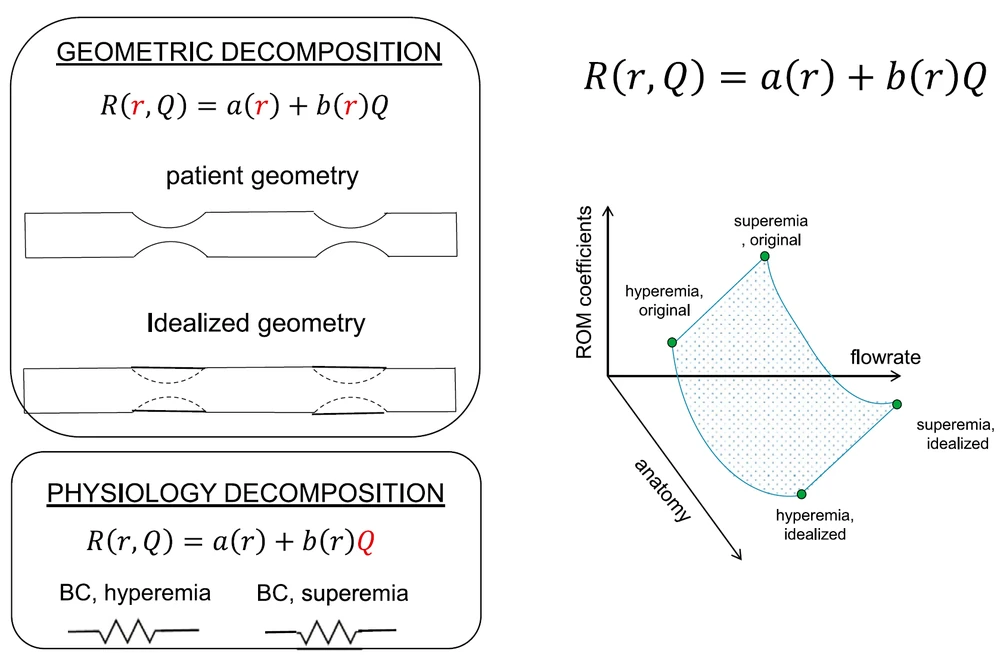
Data-Calibrated Reduced-Order Modeling
We construct one-dimensional reduced-order models in which geometry-dependent pressure–flow relationships are calibrated from a small set of three-dimensional CFD simulations. The calibrated coefficients account for pressure losses associated with stenosis, curvature, branching, and other geometric features that are difficult to represent with empirical relations alone. The resulting model retains the principal pulsatile hemodynamic response of each vascular geometry while reducing the cost of repeated simulations.
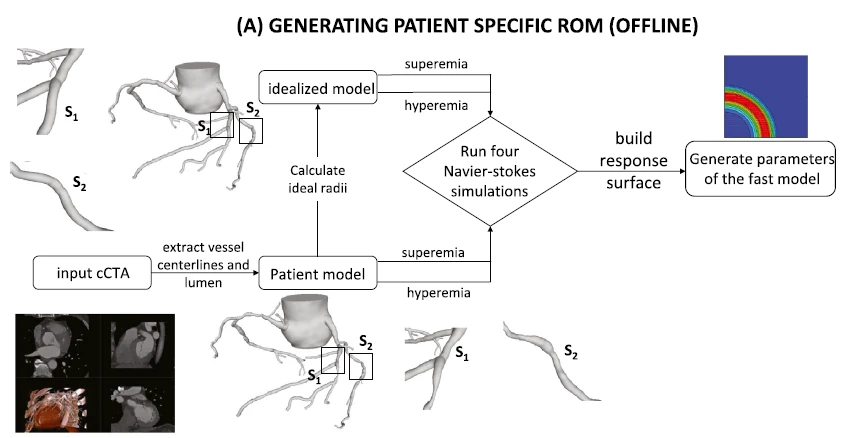
Efficient Pulsatile Hemodynamic Simulation
The calibrated reduced-order model enables efficient simulation of time-dependent pressure and flow in idealized and subject-specific vascular geometries. We evaluate the model through comparisons with full three-dimensional CFD simulations under multiple flow and anatomical conditions. This comparison allows the computational benefit of model reduction to be assessed together with the associated approximation error.
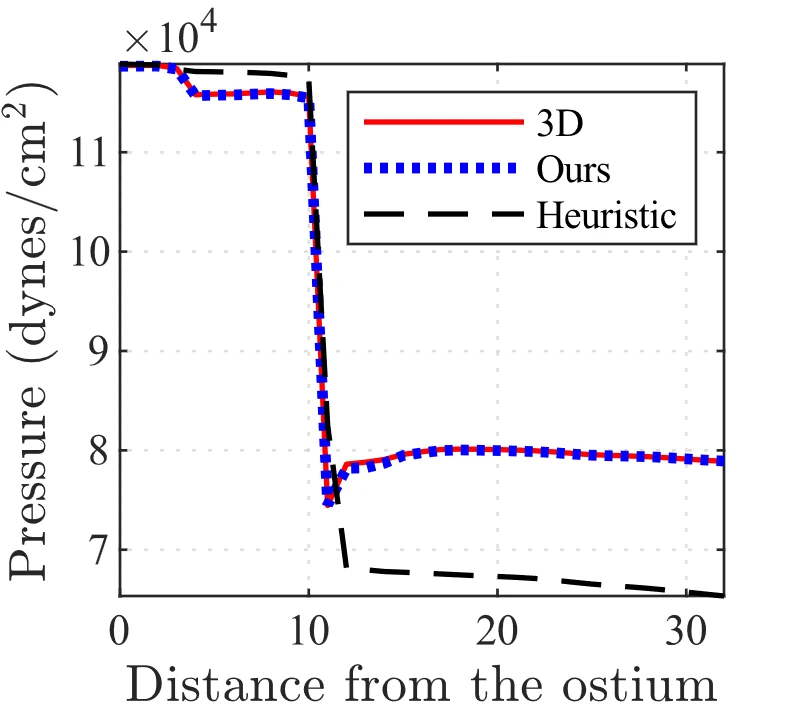
Uncertainty Quantification of Fractional Flow Reserve
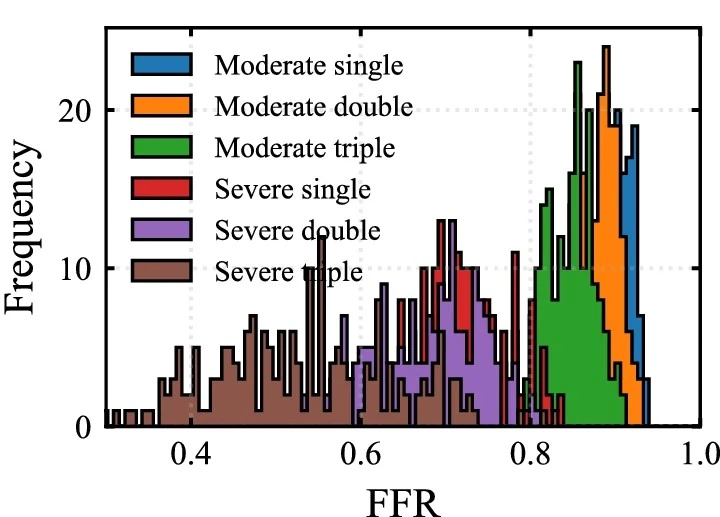
Physiological parameters and boundary conditions vary among individuals and across cardiac cycles, which introduces uncertainty into computational estimates of fractional flow reserve. We combine the calibrated coronary reduced-order model with physiologically informed lumped-parameter networks and polynomial chaos expansion. This framework propagates physiological input variability to the predicted FFR distribution at a computational cost that would be difficult to achieve with repeated three-dimensional simulations.
Global Sensitivity Analysis and Prediction Robustness
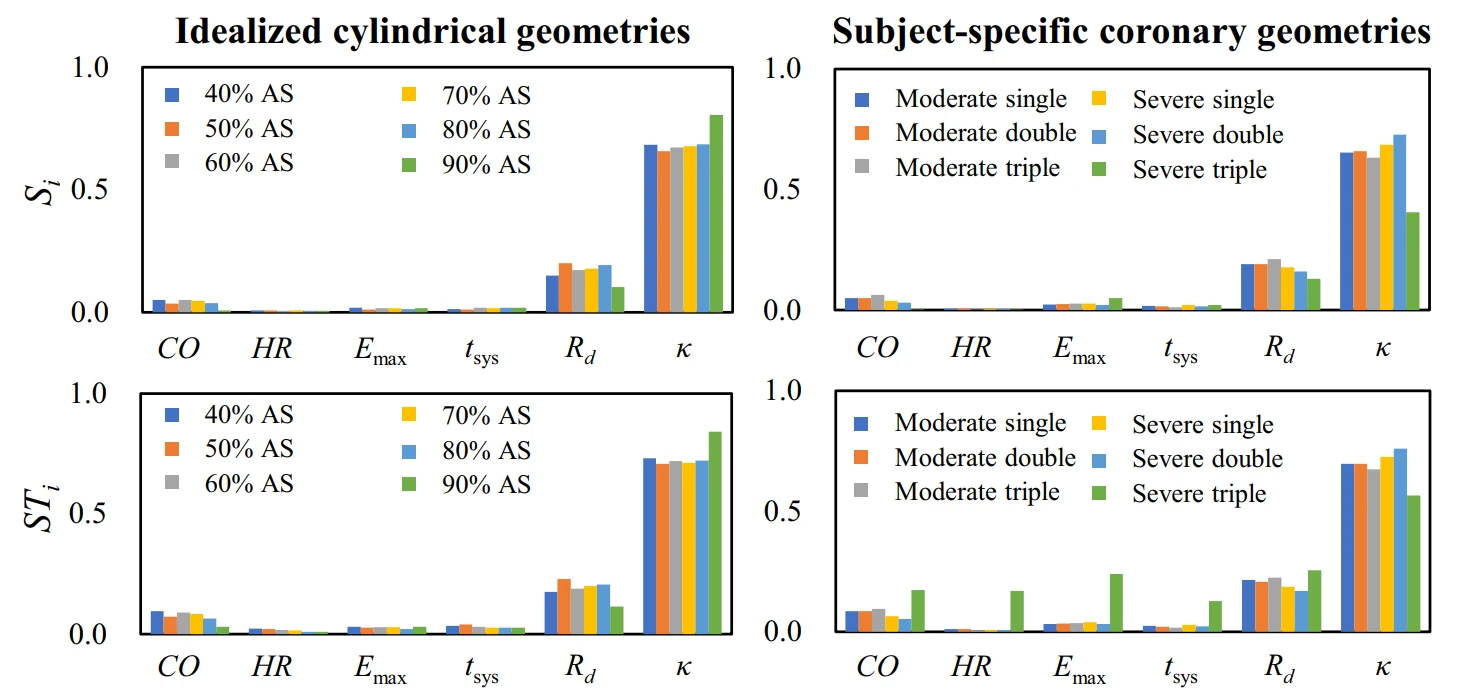
We use global sensitivity analysis to determine how individual physiological parameters contribute to variability in FFR. Under the investigated conditions, myocardial compression is the dominant contributor, followed by systemic and cardiac parameters that affect aortic pressure. The analysis also indicates that cycle-averaged FFR remains relatively robust within the investigated physiological parameter space, although its variability changes systematically with stenosis severity.
Model Verification and Scope
We assess reduced-order predictions against full three-dimensional CFD results before their use in large-scale parameter studies. Model performance is evaluated in terms of waveform agreement, spatial pressure distribution, relative error, computational cost, and robustness across anatomical and physiological conditions. The calibrated model is intended to complement, rather than replace, high-fidelity simulation when detailed three-dimensional flow structures are required.
| Suited to the reduced-order model | Requires full three-dimensional CFD |
|---|---|
| Pulsatile pressure and flow | Local velocity structures |
| Parameter sweeps | Recirculation and secondary flow |
| Uncertainty quantification | Detailed wall shear stress |
| Sensitivity analysis | Complex local flow phenomena |
| Preliminary optimization | High-fidelity mechanistic analysis |
Selected work
Effects of pulsatile flow on fractional flow reserve assessed using a reduced-order model
Annals of Biomedical Engineering
Computer Methods and Programs in Biomedicine 271:108994
Physics driven reduced order model for real time blood flow simulations
Computer Methods in Applied Mechanics and Engineering 364:112963
Uncertainty quantification in coronary blood flow simulations: impact of geometry, boundary conditions and blood viscosity
Journal of Biomechanics 49(12):2540–2547