Multiscale and Multiphysics Modeling
Biological systems involve interactions among blood flow, tissue mechanics, and transport processes across multiple spatial and temporal scales. We develop computational frameworks that couple reduced-dimensional vascular models with three-dimensional tissue domains. These frameworks retain essential local physics while reducing computational cost and enable consistent exchange of mechanical and transport variables across coupled domains. Our methods support subject-specific analyses of hemodynamics, tissue deformation, perfusion, and biological transport under physiological and externally applied loading.
Hybrid-Dimensional Fluid–Structure Interaction
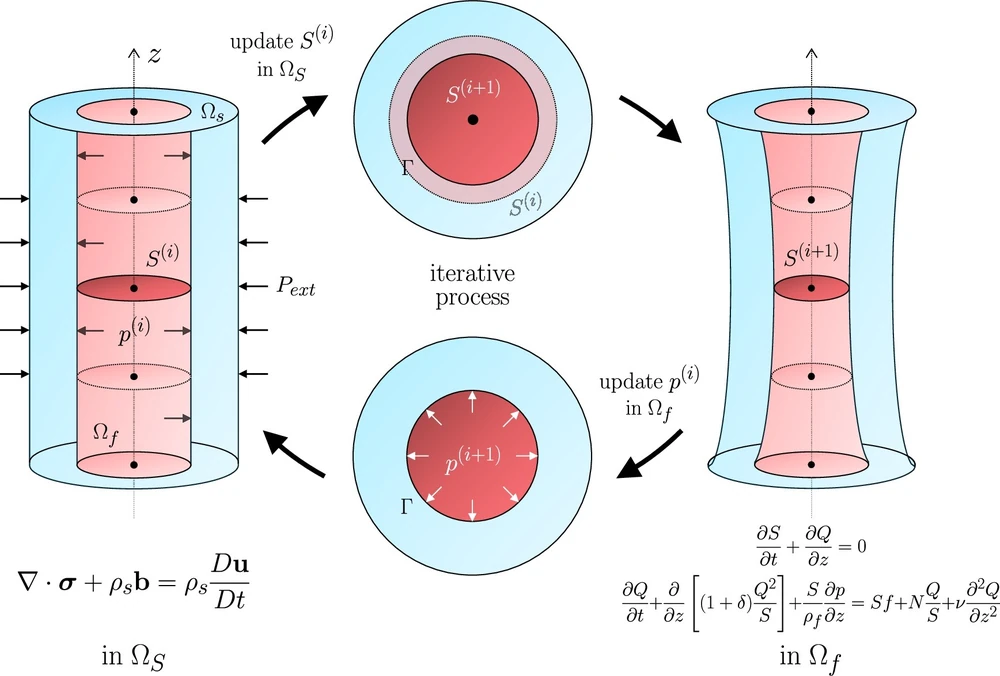
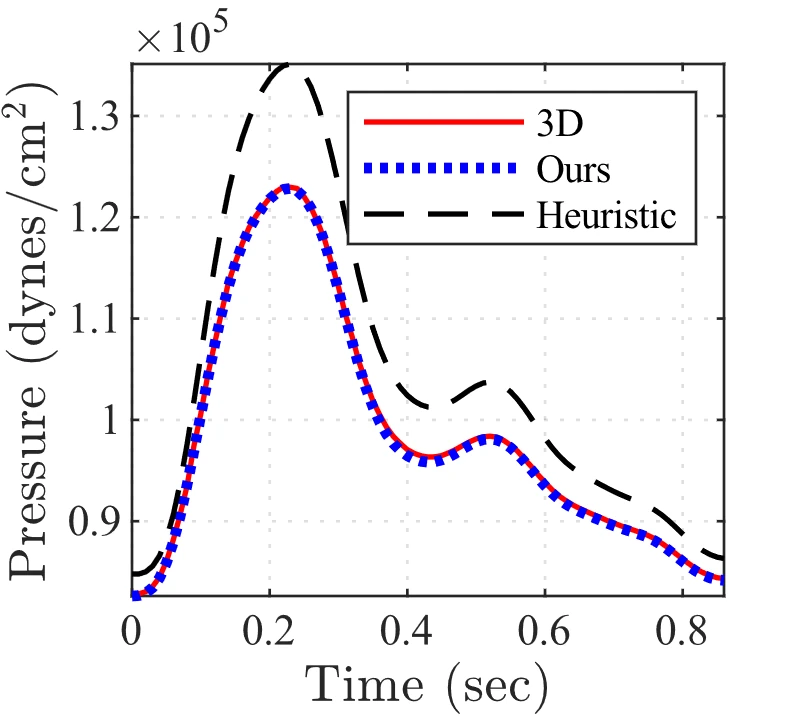
We couple one-dimensional deformable blood-flow models with three-dimensional tissue mechanics to represent the interaction among intravascular pressure, vessel deformation, and external loading. Pressure and cross-sectional deformation are exchanged iteratively between the fluid and structural domains. This hybrid-dimensional formulation preserves the principal fluid–structure coupling while avoiding a full three-dimensional fluid solution throughout the vascular domain.
Comparison with full three-dimensional fluid–structure interaction simulations demonstrates similar transient flow and deformation responses at substantially lower computational cost in both simplified and subject-specific geometries.
Multiscale Vascular–Tissue Transport
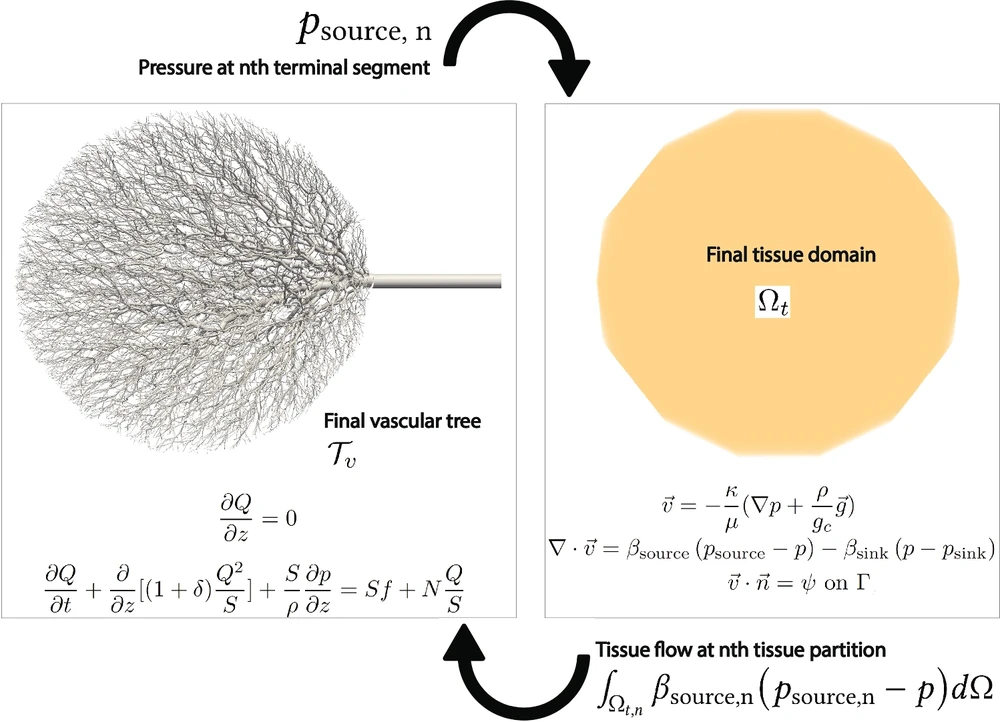
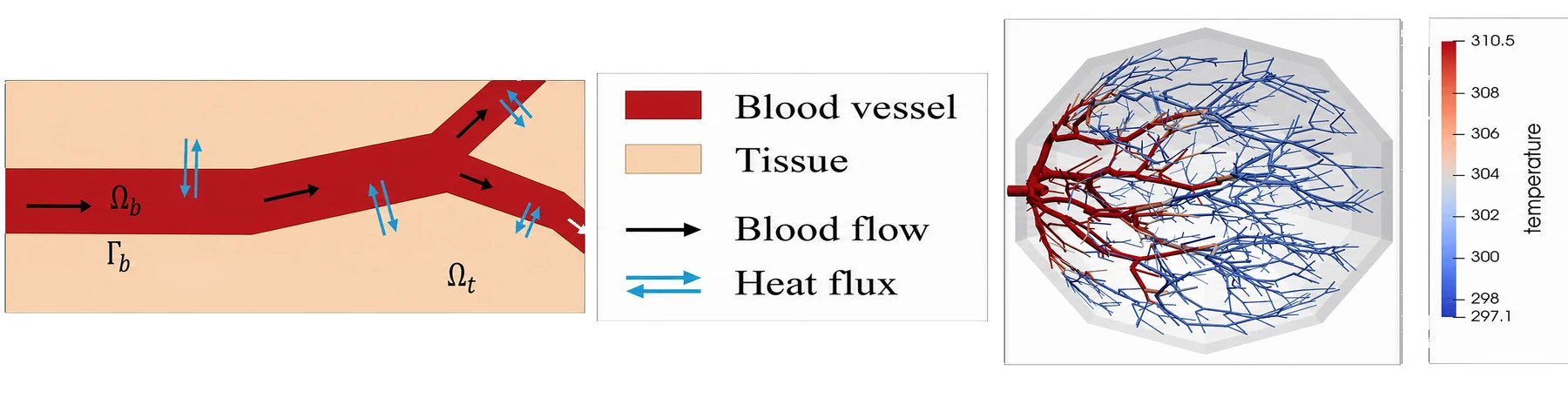
We explicitly represent larger vessels with one-dimensional flow and transport equations and represent smaller vascular structures within a three-dimensional tissue continuum. Bidirectional coupling accounts for vessel–tissue exchange and maintains consistency of energy or mass transfer across the coupled domains. This framework allows localized effects of vascular architecture and tissue heterogeneity to be examined beyond homogeneous bioheat or porous-medium descriptions.
Network-to-Tissue Hemodynamics and Physiological Regulation
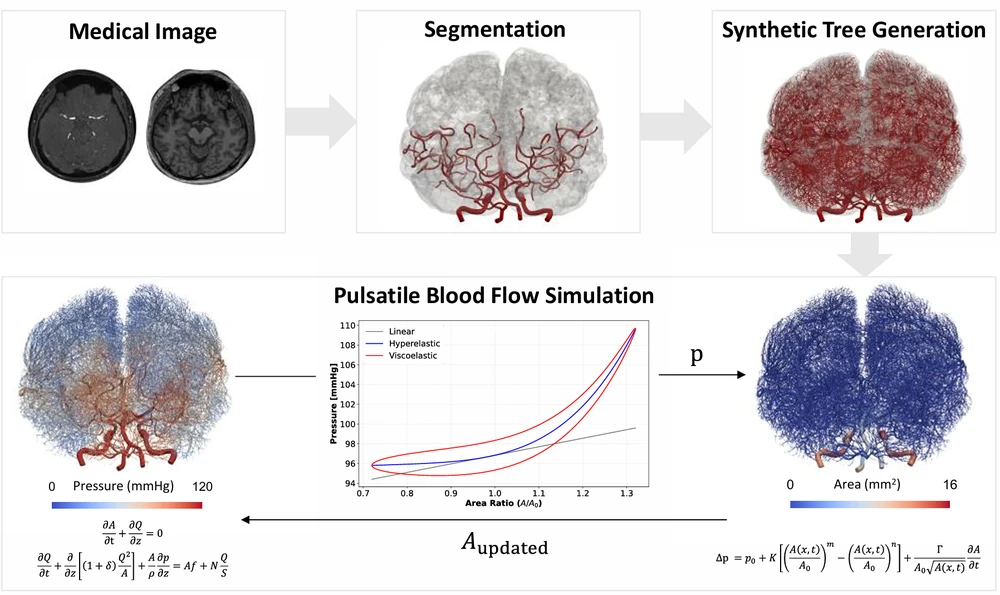
We connect arterial and venous networks, pre- and postcapillary compartments, and a three-dimensional perfusion domain to represent blood transport across vascular scales. The framework incorporates passive vessel mechanics and active autoregulatory responses to examine how systemic pressure, gravity, vascular stiffness, and metabolic demand affect regional perfusion. This approach provides a mechanistic basis for studying physiological compensation under changing conditions.
As an application, we use this framework to investigate how aortic pressure, body posture, vessel-wall stiffness, and autoregulation jointly affect cerebral blood flow and vascular volume. The cerebral results are treated in Cerebral Perfusion and Autoregulation.
Verification and Cross-Scale Consistency
We evaluate the coupled frameworks through comparisons with analytical solutions, full-order simulations, and established numerical solvers, as appropriate for each model. The evaluation focuses on interface consistency, conservation of transported quantities, transient response, numerical accuracy, and computational cost before application to subject-specific problems.
Selected work
Annals of Biomedical Engineering
Multiscale modeling of posture-dependent cerebrovascular hemodynamics with autoregulatory coupling
Computers in Biology and Medicine 203:111502
Multiscale transport modeling in biological tissue
Computer Methods in Applied Mechanics and Engineering