Abdominal Aortic Aneurysm Hemodynamics and Mechanics
Abdominal aortic aneurysm involves substantial changes in both blood-flow dynamics and the load-bearing behavior of the aortic wall. Our research develops computational models to examine pulsatile and transitional flow, wall deformation, intraluminal thrombus, and regional mechanical loading. We combine patient-specific computational fluid dynamics, fluid–structure interaction, and stress-to-strength analysis to investigate how vascular geometry, material properties, and physiological conditions influence biomechanical indicators associated with rupture.
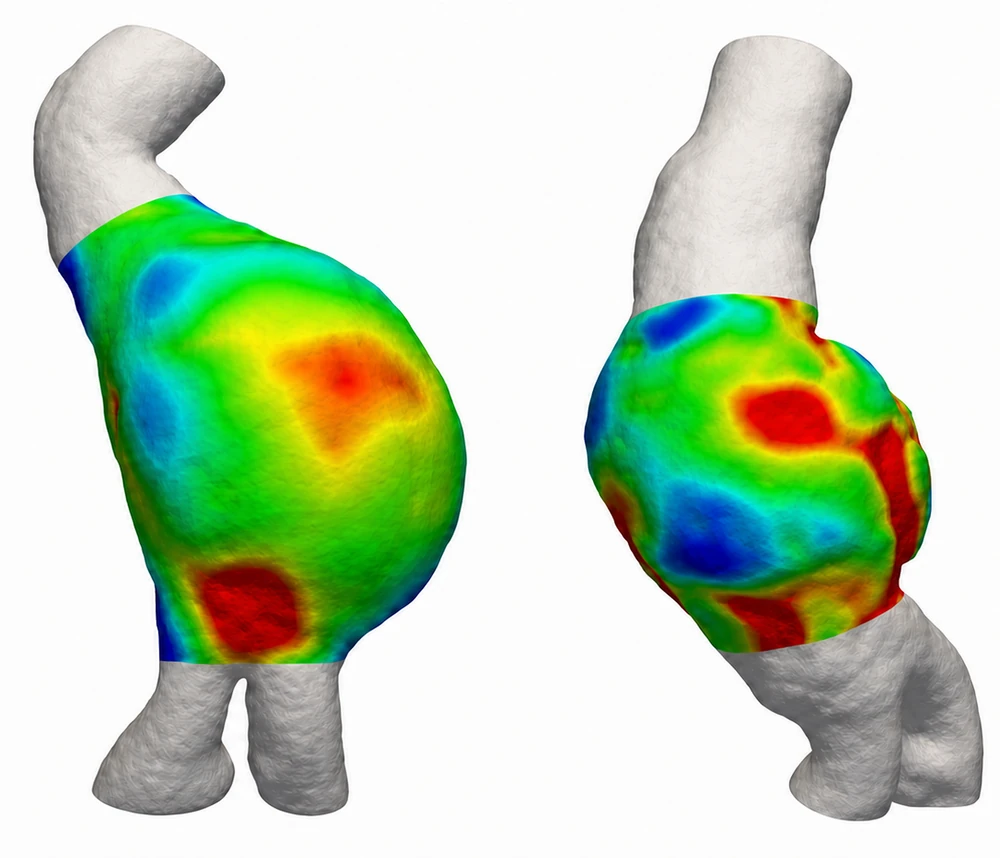
Patient-Specific Aneurysmal Hemodynamics
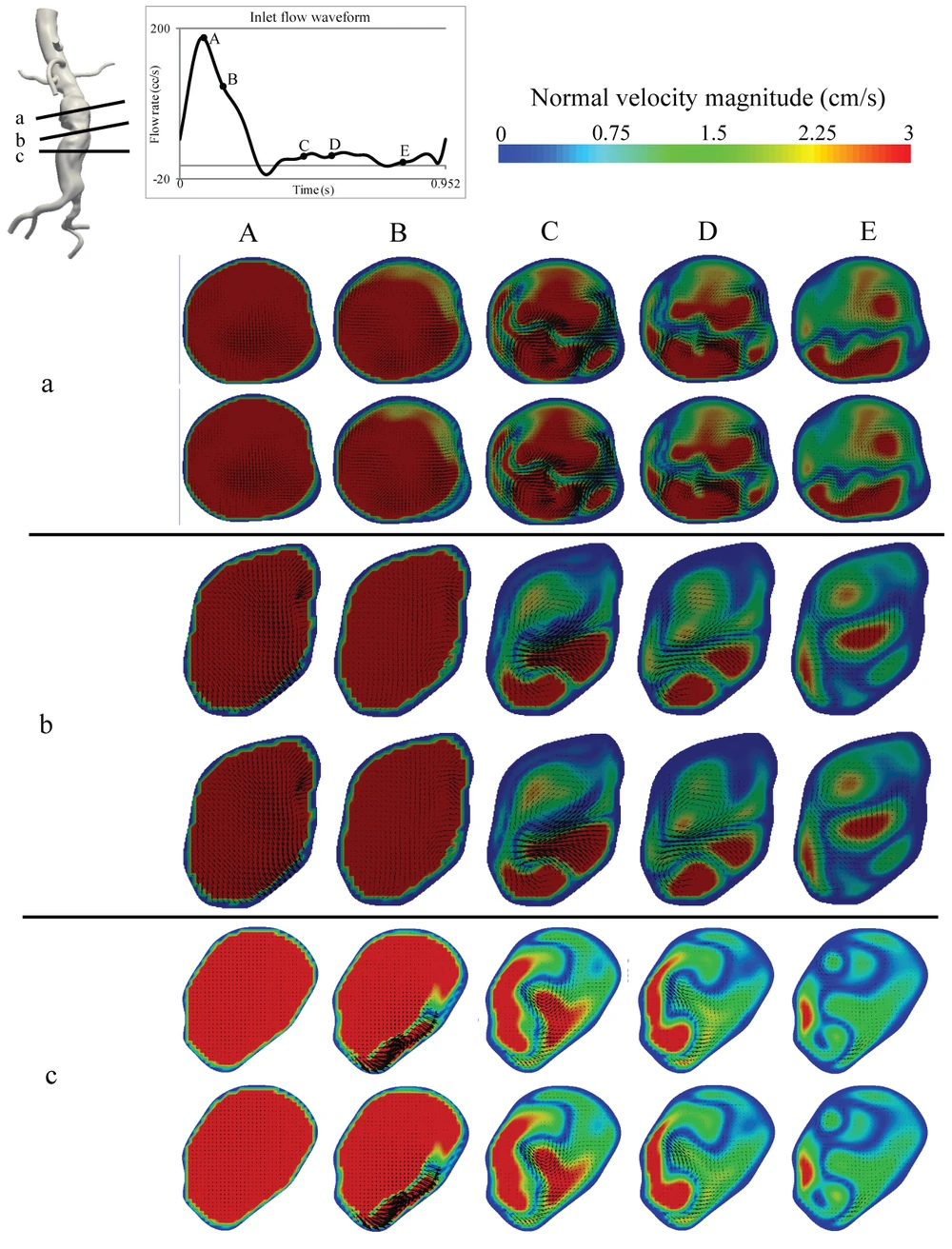
We perform pulsatile CFD simulations in patient-specific aneurysm geometries to characterize disturbed and transitional flow within the aneurysm sac. Phase-averaged analysis over multiple cardiac cycles is used to distinguish persistent flow structures from instantaneous fluctuations, and to establish how many cycles an average has to cover before it can be relied on.
Fluid–Structure Interaction and Wall Mechanics
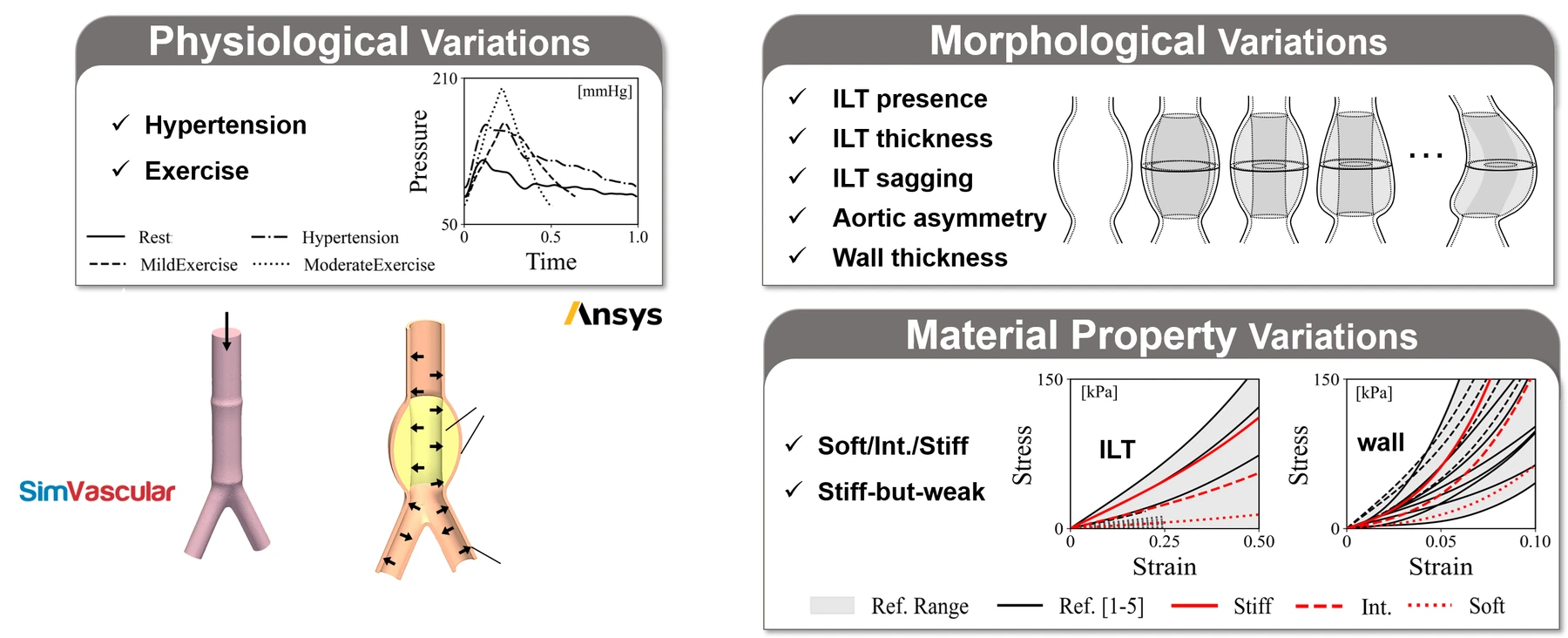
We couple hemodynamic and structural analyses to quantify aneurysm-wall deformation and regional mechanical stress under pulsatile loading. The models account for variations in aneurysm geometry, wall properties, intraluminal thrombus, and blood pressure. Pressure obtained from the flow solution is applied to a structural model in which the wall and the thrombus carry separate material descriptions, so that the response of each can be read on its own.
Stress-to-Strength Assessment of Rupture Susceptibility
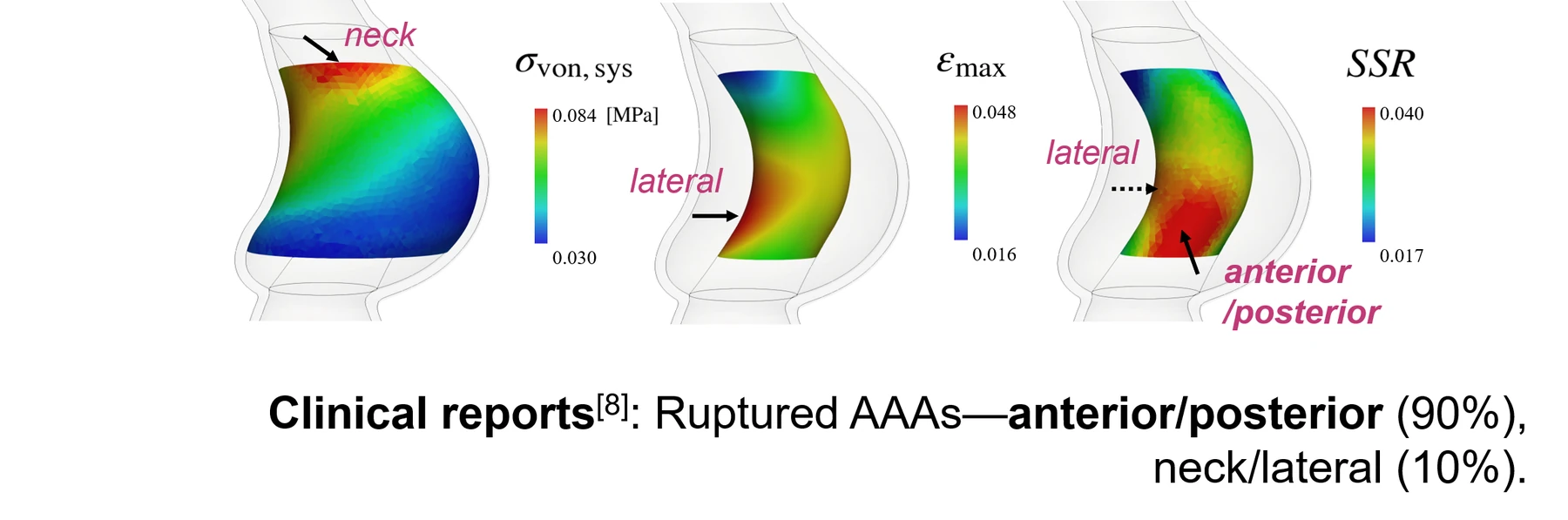
We evaluate regional rupture susceptibility through dimensionless stress-to-strength metrics that compare mechanical loading with the estimated strength of the aneurysm wall and intraluminal thrombus. The framework examines the combined effects of thrombus morphology, wall thickness, blood pressure, tissue stiffness, and aneurysm geometry. This work is ongoing: the metric is being evaluated as a biomechanical indicator across idealized aneurysm models with variations in morphology, material properties, and physiological loading, and the study listed below is under revision.
Selected work
Efficient estimation of vessel wall stress under pulsatile hemodynamics via a snapshot-based coupling framework
Computer Methods and Programs in Biomedicine
Stress-to-strength ratio for assessing rupture risk in abdominal aortic aneurysms: a computational study
Computers in Biology and Medicine
Convergence of phase-averaged, transitional flow in an abdominal aortic aneurysmal model
Journal of Biomechanical Engineering 145(11):111007