Coronary Hemodynamics and Ischemic Heart Disease
Coronary artery disease alters the pressure and flow patterns that govern myocardial perfusion. Our research develops patient-specific computational models to quantify the hemodynamic effects of coronary stenosis, pulsatile physiology, and collateral circulation. We combine three-dimensional computational fluid dynamics with calibrated one-dimensional reduced-order models and physiologically based boundary conditions to simulate coronary blood flow efficiently. These models support the analysis of fractional flow reserve, physiological variability, and perfusion in chronic total occlusion.
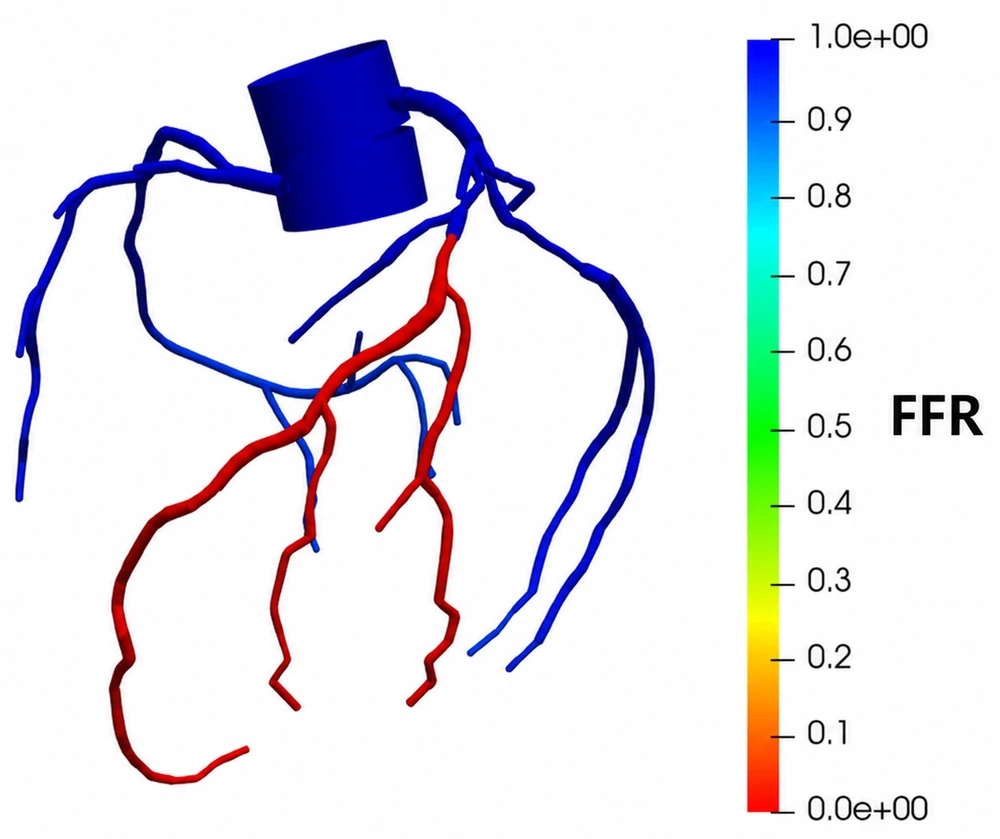
Patient-Specific and Reduced-Order Coronary Modeling
We reconstruct patient-specific coronary geometries from medical images and use three-dimensional CFD to characterize geometry-dependent pressure–flow relationships. These results are incorporated into one-dimensional reduced-order models for efficient simulation of pulsatile flow in complex stenotic vessels.
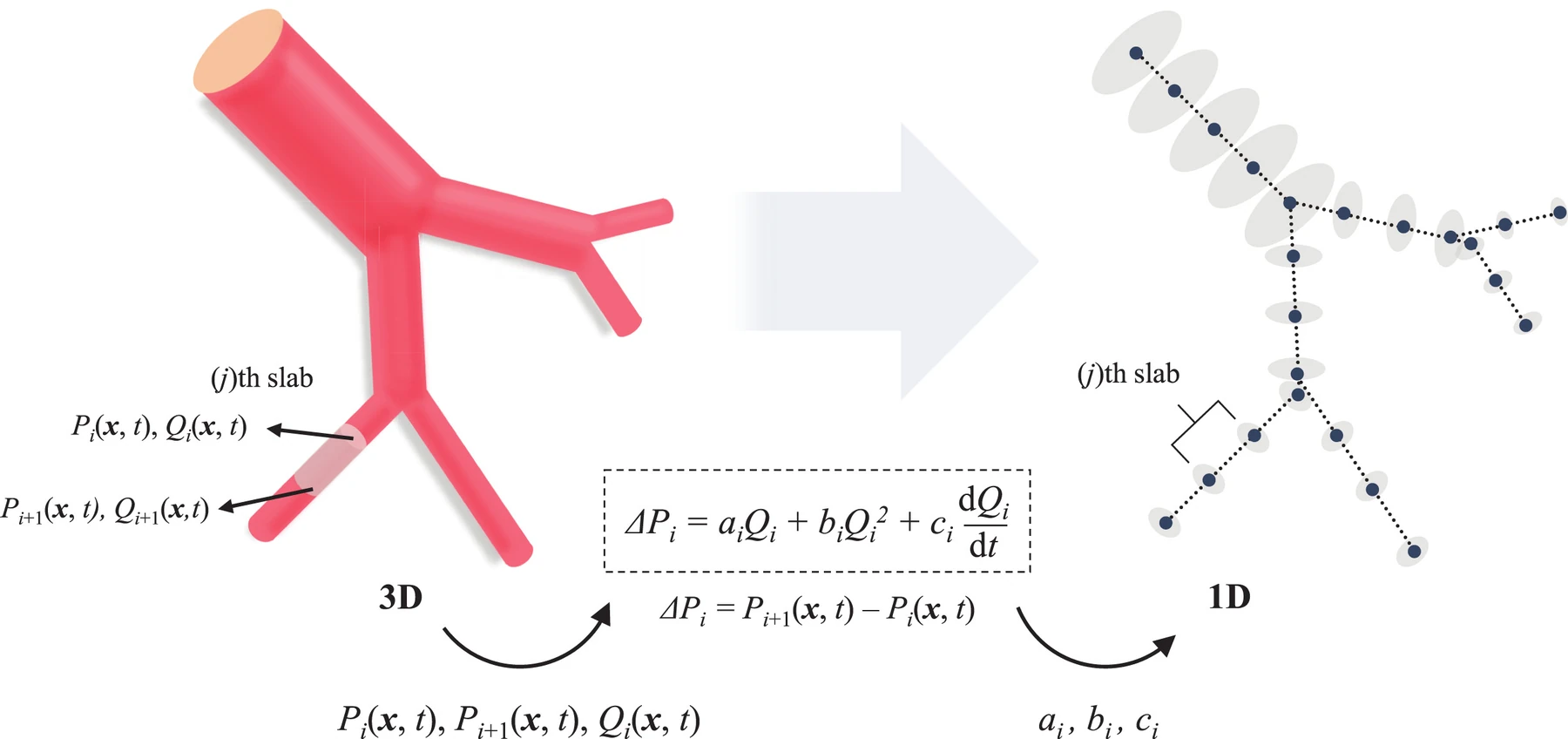
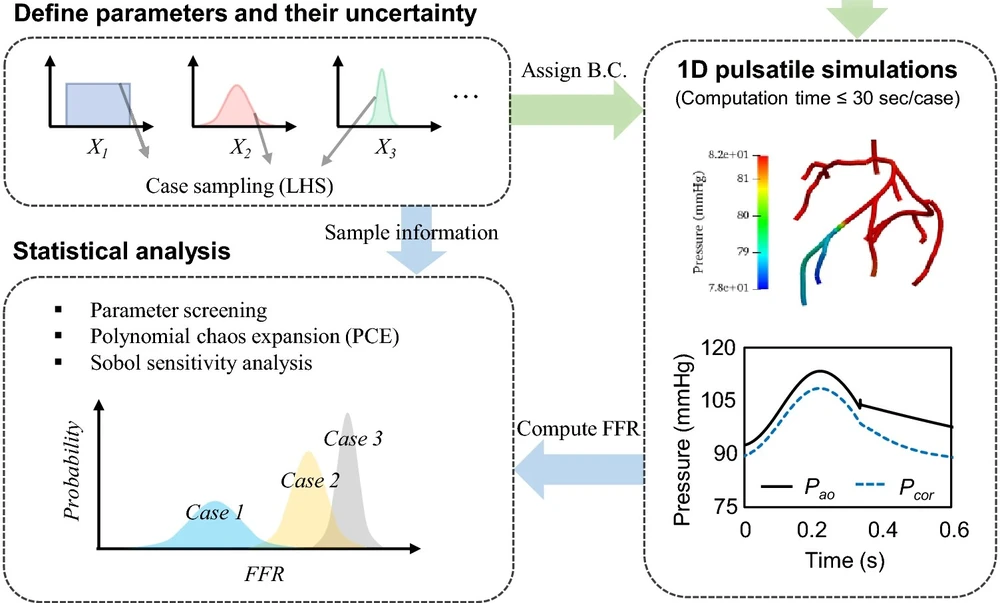
Fractional Flow Reserve and Physiological Variability
We couple reduced-order coronary models with physiologically informed lumped-parameter models to simulate pulsatile coronary hemodynamics. Uncertainty quantification and global sensitivity analysis are used to assess how myocardial mechanics and systemic physiological variability affect computed fractional flow reserve.
Chronic Total Occlusion and Collateral Circulation
We construct virtual coronary models to investigate how collateral-vessel characteristics affect pressure recovery and myocardial perfusion distal to a chronic total occlusion. Large-scale simulations allow systematic comparison of anatomical and physiological conditions that cannot be evaluated efficiently with conventional three-dimensional models alone. This work is ongoing; the study of 45,000 virtual cases listed below is under review.
Selected work
Effects of pulsatile flow on fractional flow reserve assessed using a reduced-order model
Annals of Biomedical Engineering
Computer Methods and Programs in Biomedicine 271:108994
Myocardial perfusion simulation for coronary artery disease: a coupled patient-specific multiscale model
Annals of Biomedical Engineering 49(5):1432–1447
Predicting the physiological effect of revascularization in serially diseased coronary arteries: clinical validation of a novel CT coronary angiography-based technique
Circulation: Cardiovascular Interventions 12(2):e007577
Collateral diameter, rather than collateral number, determines hemodynamic relief in chronic total occlusion: a computational study of 45,000 virtual cases
Circulation: Cardiovascular Interventions